What Separates Good Guitarists from Great Ones
How deep can you go into a piece? With some stories from my students and practical examples

Last week, a student told me something that stopped me in my tracks. He was practicing Lagrima by Tarrega and he said: "I think I've reached the maximum of this piece. It's very simple, so there's nothing more to do."
I'll let you imagine my face. Not because I was offended. But because I knew that what was about to happen in that lesson would surprise us both. And it did.
This video — and this post — are about that lesson. About how deep you can really go into a piece. And about what actually changes between a beginner, an intermediate player, and a truly musical guitarist.

Level 1: Let's Be Honest
When my student played Lagrima for me, the most obvious thing was the technical problems. And the most common ones were these:
Buzzing notes
That rough, metallic sound when a note doesn't ring clean. It's one of the most frustrating problems for beginners, but the good news is that it almost always comes down to three things: the position of your fingers on the fret, the pressure, and the shape of your hand.
The most important thing is where you land. If you press at the beginning or in the middle of the fret, buzzing is very likely. But if you land right at the end — just before the fret wire — you'll get a clean sound.
As for shape: if you curve your fingers into an arch, you use the natural weight of your hand instead of forcing extra pressure. The difference between a buzzing note and a clean one is very, very small. Try it slowly, and you'll hear it immediately.

Lack of legato
In music, we have two main types of articulation: legato and staccato.
Staccato means the sound is shorter than the actual duration of the note — each note is cut off, separated from the next. Legato is the opposite: no silence between notes, like singing. One continuous breath.
When my student played, every note was slightly detached. It sounded choppy, almost percussive — when the piece really needs to flow like a melody you could hum.
This is extremely common among beginners, and the cause is almost always the same: the left hand lifts too early. The fix? Don't be afraid to stay on the strings. Keep pressing until the very last moment.

No balance between melody and accompaniment
This one is subtle, but it changes everything.
Lagrima has two voices happening at the same time: the melody on top, and the accompaniment below. When my student played, the accompaniment was so loud it was completely drowning out the melody. You could barely hear the tune.
And in this piece, the melody is everything. If you can't hear it, you lose the whole point of the music.
The time — correct, but mechanical
The notes were in the right place. The rhythm was technically accurate. But it sounded like a machine playing it — no dynamics, no breathing, no phrasing. Just notes, one after the other.
That's when he admitted: yes, maybe there was still something to improve. But it was nothing compared to what we did next.


Level 2: clean, correct, but…
Once the technical problems were solved, something already beautiful happened. No more buzzing. The guitar is singing now. The melody is on top, clearly audible, and the accompaniment supports it instead of fighting it. It doesn't sound like MIDI anymore.
And honestly? This is already a huge step. Most listeners would hear this and say: "That sounds great."
But here's the uncomfortable truth about Level 2: you sound good, correct, pleasant — but not memorable.
Everything is in the right place. You know what you're doing. There are no obvious mistakes to fix. And it's very easy to think: okay, I'm done.
That's exactly the trap.
Because at this point, the real work hasn't even started yet. All you've done is remove the obstacles. Now you have to actually play — with intention, with direction, with something to say.

Level 3: When Technique Disappears
Level 3 is forgetting about technique entirely, and becoming a musician who tries to touch the souls of many.
Repeating a phrase is never an accident
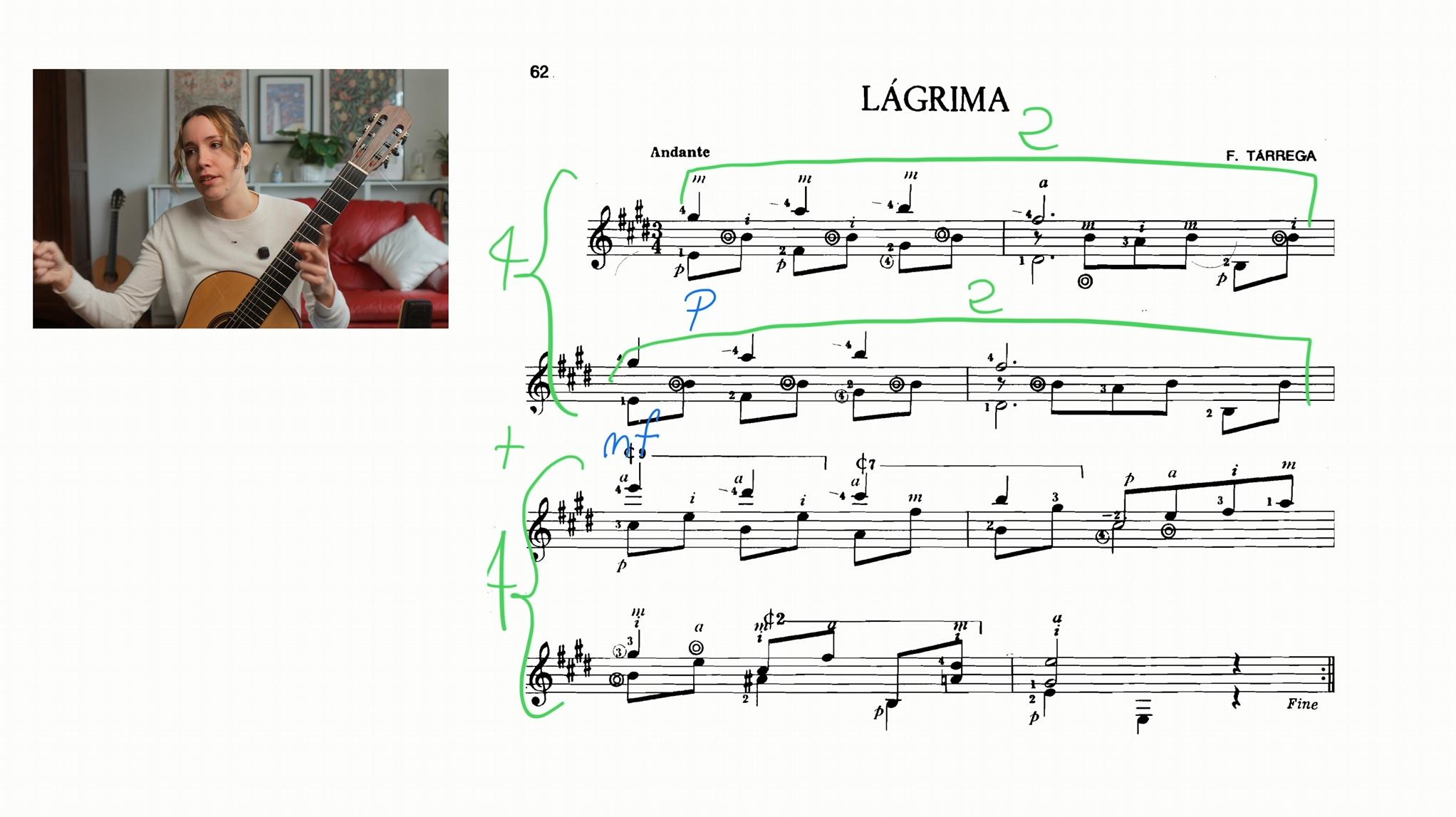
In the first section of Lagrima, the same short phrase is repeated twice. In everyday life, when you say something twice, it's because you want to reinforce it — to make sure the other person really hears you. Music works exactly the same way.
So that repetition has meaning. The first time: a small crescendo, contained — piano, with a wave inside, but not too much. The second time: more. More intensity, more direction. Because we're building toward something important.
The accompaniment has a voice too
As the melody grows toward the highest point of this section, the accompaniment doesn't just sit quietly below. It builds with it — like an orchestra swelling behind a soloist, announcing that something big is coming.
And then, after that peak, what happens? Like a jump — you fall back to the floor. But gently, gradually. The music breathes out.
Phrases have a beginning and an end
If you look at the sheet music, you'll see four bars plus four bars — connected. One long thought, not eight separate ones.
Phrasing means understanding that. It means you don't just play straight through from note to note. There's a direction, a shape. And at the end of each phrase, you slow down — not because the metronome says so, but because a phrase needs to close, like a sentence needs a pause before the next one begins.
When you're not sure how a phrase should feel, try singing it. You'll immediately know where to breathe. Your voice will tell you what your fingers sometimes can't.
What really happens at Level 3
You stop thinking about the notes. You stop worrying about mistakes. You just play.
Technique disappears — not because it's gone, but because it's become invisible. It's there, holding everything up, but you're no longer aware of it. All you're aware of is the music.
And when that happens, the people who listen to you don't just hear the piece. They feel it. That's the difference. That's what we're really working toward.
There Is No Finish Line
Today I showed you three levels of playing. But don't think there is a limit — and don't think that perfection is the goal, because perfection does not exist. If perfection is your goal, you can only fail.
Play and practice. There is a physiological time frame of years. Sometimes pieces improve without playing them. Sometimes they improve simply by improving ourselves.
And the opposite is also true: if you think a piece is finished, you're probably missing something.
Watch the Full Video
Everything I described here comes alive in the video — with the music, the demonstrations, and a full comparison of all three levels at the end.
With love,
Roberta